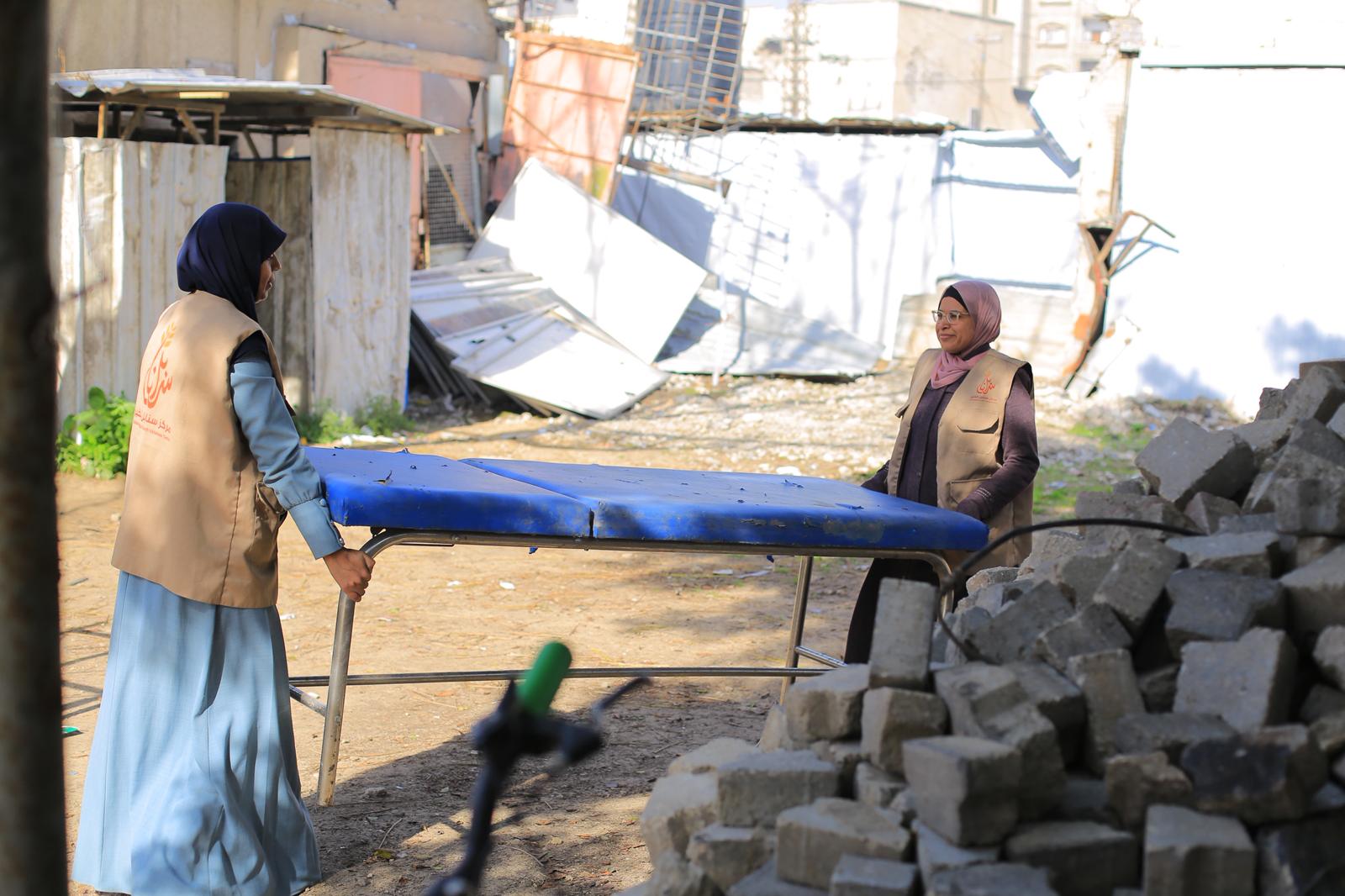
If you’ve been searching for a trustworthy way to donate to Gaza, here’s something worth knowing: some of the most effective relief isn’t coming from large institutions. It’s coming from grassroots leaders already on the ground — and a network of small donors backing them directly.
Before the genocide, Amani Abed was a software engineer and startup founder. Her EdTech platform, built for university students in Saudi Arabia, secured financing from Google and the World Bank. By most measures, she’d already built the kind of career success story that gets written up in business press.
Then she pivoted everything — her skills, her network, her resources — into founding Zad al-Ghad, a Ministry of Education-accredited school in Gaza City built to recover two years of lost education for primary school-aged children. Not a side project. Not a temporary relief effort. A real school, built by someone who knew exactly how to build things, because building was already what she did.
When Zad al-Ghad needed to reach its $10,000 crowdfunding goal through Nourishing Hope for Gaza, it didn’t take months of proposals and reporting cycles. It took a vetting conversation, a crowdfunding push, and a network willing to move.
Since June 2024, Nourishing Hope for Gaza has run 11 campaigns, raising $72,574.38 directly for grassroots leaders like Amani — money that moved without a single grant proposal.
That speed is not an accident. It’s the model. And two years into running Nourishing Hope for Gaza, we want to share the tactical lessons.
1. There is no shortage of builders in Gaza
Between our open call for Nourishing Hope partners, or for our flagship Root fellowship, we receive hundreds of applications from inside Gaza. Not requests for handouts — proposals. People already running something: a school, a clinic, a theater company, a relief network for a community everyone else has overlooked. The talent and the will to build were never the missing ingredient. What’s been missing is a fast, trustworthy way to connect that work to resources.
2. Mutual aid moves faster than institutional aid
Our current and past Nourishing Hope partners span an unusual range beyond Amani’s school: Sanabel al-Kheir, a youth collective that opened an emergency medical point after Gaza City’s health centers were destroyed. Child Smile, a theater initiative led by displaced artists from the now-destroyed Theatre Day Productions center, using drama to help children process what they’ve survived. Deaf Relief Gaza, led by a former teacher of Deaf students who, when the genocide began, started organizing relief for Gaza’s Deaf community himself: food, hygiene supplies, hearing aids, mobility devices for people too often forgotten twice over. His campaign’s $7,000 goal closed at $8,440. A diabetes association keeping children supplied with insulin. A scholarship initiative now supporting 450 students toward university.
None of these campaigns moved through layers of proposal review, compliance audits, or multi-month grant cycles. We vet them, we boost them through our network, and funds go directly to the organizers. No middle layer slows it down. That’s not a shortcut — it’s a structural choice that treats Gaza’s community leaders as the experts on what their communities need, because they are.
3. Don’t underestimate the power of small donors
Large donations make a campaign leap forward. But it’s small, recurring donors who fill the gaps between leaps — and they do something a single large gift can’t: they build a visible community of people standing behind one specific project. When dozens of people are chipping in $15 or $25 a month to support Zad al-Ghad school in Gaza City, that’s not just funding. It’s a signal to Amani Abed, who shifted her whole life’s work to build the school, that her work is seen and backed by people she’s never met. That recognition matters as much as the dollar amount.
A recurring monthly gift also does something a one-time donation structurally can’t: it lets a project plan. A single $500 donation is generous, but it’s a one-time event — the organizer still doesn’t know what next month looks like. Fifty people giving $10 a month is the same total, but it behaves completely differently: it’s predictable, renewing income a community leader in Gaza can actually build around, rather than a windfall they have to stretch and hope lasts. For someone running a school, a clinic, or a relief network under constant uncertainty, that predictability is its own form of relief.
4. This could be a model for aid going forward — not just an emergency bandage
The instinct in crisis response is to treat speed and accountability as a trade-off: move fast and skip the scrutiny, or slow down and do it “properly.” That instinct assumes scrutiny has to live in paperwork — in proposal cycles, audits, and reporting requirements that can take months before a single dollar moves. Nourishing Hope is testing a different premise: that scrutiny can live in relationships and verification instead of bureaucracy. Every partner reaches us through our existing network of local social impact organizers — people we already trust, vouching for someone they know. From there, our team meets the founder directly, verifies the work on the ground, and checks that their values align with ours before a single dollar is raised on their behalf. Because funds go directly to organizers with no intermediary taking a cut or adding a layer of delay, the accountability isn’t weaker — it’s just located somewhere different: in who we choose to vet, not in how much red tape we wrap around them afterward.
We don’t think this should only apply during emergencies. It’s a live argument for what Palestinian-led aid could look like permanently — community leadership treated as the expert rather than the risk, and real, trackable results arriving in weeks rather than years.
Amani puts it more plainly than we could. Describing what she’s actually building at Zad al-Ghad, she said her goal is shifting her community’s mindset “from ‘waiting for aid’ to ‘creating solutions.'” That’s the whole model, in five words.
Where you come in
This model only works because people outside Palestine are willing to be part of it. There are two ways to do that right now.
Become a Nourishing Hope for Gaza Champion. Join a growing global network of people committed to amplifying our partners’ campaigns and stories — sharing, donating, and helping a project on the ground in Gaza reach the people who’d want to support it if they knew it existed.
Organize your workplace, local Palestine solidarity group, or your friend group around one partner. Commit to a monthly amount for a specific Nourishing Hope partner, and offer mentorship or institutional support to a project on the ground. It’s the small-donor model from #3, scaled into something a team or community can build together — and a way to give a project in Gaza not just funds, but a standing group of people in its corner.
Become a Nourishing Hope for Gaza ChampionFrequently asked questions
What’s the best way to donate to Gaza right now? Supporting a vetted, locally-led project — rather than giving to an unfamiliar fundraiser directly — is one of the most reliable ways to make sure your donation reaches people on the ground quickly. Nourishing Hope for Gaza vets active grassroots campaigns in Gaza and connects them to a global network of donors, so funds go straight to the organizers running the work.
Is mutual aid more effective than traditional humanitarian aid in Gaza? Mutual aid and institutional aid solve different problems. Large institutions can move significant resources but often move slowly, weighed down by review and reporting cycles. Mutual aid moves faster because it puts trust and funding directly in the hands of community leaders who already know what’s needed — which is why a campaign like Deaf Relief Gaza or Zad al-Ghad School can close its funding gap in weeks, not months.
How do I know a Gaza crowdfunding campaign is legitimate? Look for an organization that vets campaigns through real relationships, not just an online application. Nourishing Hope for Gaza partners come to us through our existing network of local social impact organizers, who vouch for people they already know. From there, our team meets the founder directly, verifies the work on the ground, and confirms shared values before we boost a single campaign — and funds go directly to the campaign organizers, not through BuildPalestine as an intermediary.